
MEDICA 2025, the world’s largest medical device exhibition, was more than just a showcase of technology; it clearly demonstrated the future direction of medical device design. PINO directly observed the MEDICA field and produced the MEDICA 2025 TREND REPORT based on thousands of exhibited medical devices, environments, and user flows.
Medical device design is no longer just a matter of a well-made machine. It is expanding into a realm that designs trust, hygiene, user experience, and the relationship with space. MEDICA 2025 (Düsseldorf, Germany) is at the forefront of this change. With approximately 80,000 professionals and 5,800 companies from 72 countries participating, we confirmed one clear message.
The most impressive aspect of MEDICA 2025 was not the AI, big data, or automation technology itself, but rather the form and language used to deliver those technologies. The common characteristics shown by many medical devices are as follows:
- UI configurations that organize the experience rather than merely exposing functions.
- Restrained color strategies centered on white, gray, and black.
- Stable mass and soft curves that reduce mechanical intimidation.
- UI configurations that organize the experience rather than merely exposing functions.
This demonstrates that medical devices are no longer perceived as equipment that boasts of technology, but as objects that build trust within a space.
From Softer to More Essential
The rounded forms emphasized until 2025 are being minimized. For 2026, the trend is expected to shift toward a return to basic geometric shapes such as squares and circles, along with floating designs that conceal floor structures. Furthermore, greige tones and matte textures that reduce excessive contrast will become central. This signifies that medical device design is moving from design to be seen to design to be felt.
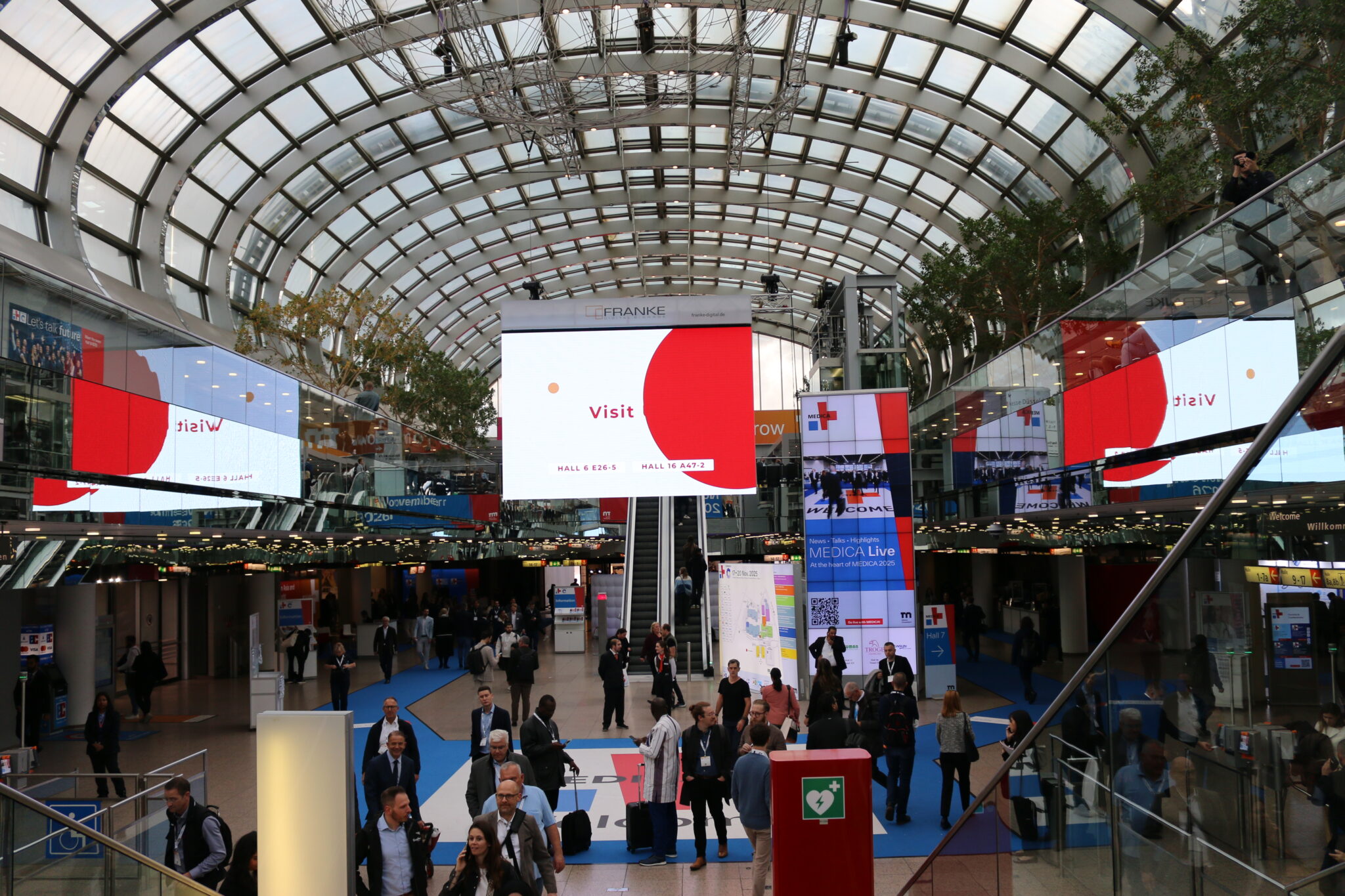
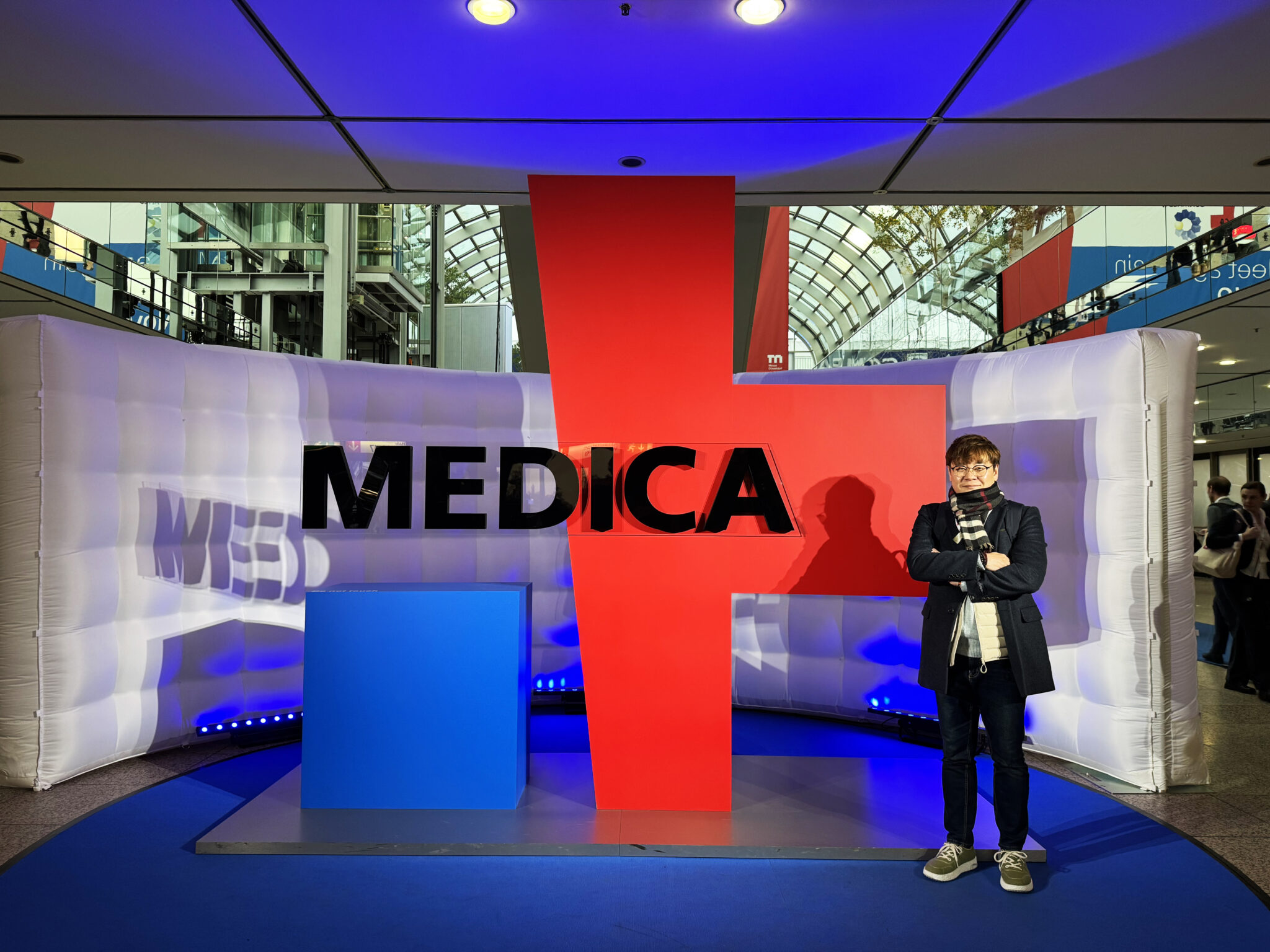
This report was analyzed based on actual products and design languages observed at MEDICA 2025.
01. Design Trends in Diagnostic and Testing Equipment
– Stable mass and structural reliability
– Monotone strategy centered on white, gray, and black
– Vertical layouts and space-efficiency-oriented design
02. Changes in Surgical and Therapeutic Device Design
– Curved-centered modeling that reduces mechanical intimidation
– Fully integrated design of cables and accessories
– Object-like design of medical devices
03. Direction of Portable and Modular Medical Devices
– Structures that secure both mobility and stability
– Seamless design that conceals buttons and joints
– Form factors considering home, clinic, and hospital environments
Clear Predictions for 2026
We present the 2026 design trends based on the observations from MEDICA 2025.
– Rounded Box → Silent Geometry
– Return to essential geometric forms from soft curves
– Shift to Greige and matte textures from high-contrast White and Black
– Transition from design to be seen to design to be felt
Why are we releasing this report for free?
PINO produced this report not as a simple exhibition summary, but to create a practical reference point that genuinely assists in the field of medical device design. We hope this report serves as an organized starting point for companies contemplating the direction of their next product development, practitioners who need to organize medical device design strategies, and planners who want to structurally understand global trends. By sharing our insights, we aim to support partners who are dedicated to proving the value of technology through design and innovating user experiences in the medical field.
MEDICA 2025 TREND REPORT
PINO
A record of how medical devices should exist within spaces and for people, moving beyond technology.